THE WORKER NOTICE ACT
A Proposal for Federal Legislation
Submitted by: Donnie Rakestraw
U.S. Army Combat Engineer Veteran
Paola, Kansas
Contact: supertech007@gmail.com
THE PROBLEM
American workers lose legal rights every day to deadlines they were never told existed.
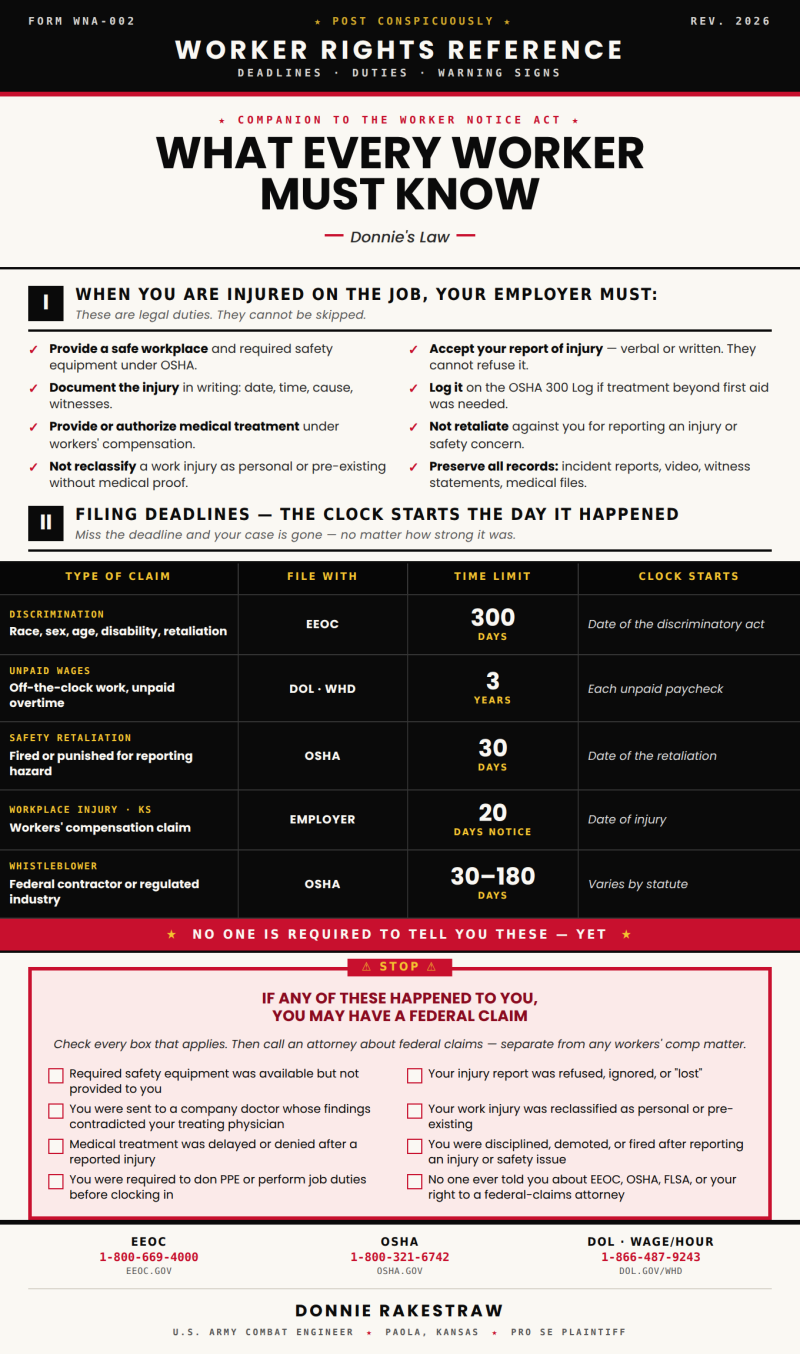
A worker who is injured, discriminated against, denied accommodation, or retaliated against has a narrow window to file a federal claim—often 180 or 300 days for EEOC charges, two years for FLSA wage claims, and sometimes less.
Miss the deadline, and the courthouse door closes. Permanently.
Most workers do not know these deadlines exist.
They are not clearly explained at hiring.
They are not provided when a worker reports an injury or files a complaint.
They are not given when a worker is disciplined or terminated.
Employers and their attorneys understand these deadlines. Workers often do not.
The system operates on that imbalance.
Workers’ compensation attorneys are not required to advise injured workers about federal claims or federal filing deadlines. Many do not. By the time a worker learns they may have had a federal claim, the deadline has already expired.
I lost my federal case against The Hershey Company under these exact circumstances.
A blue-collar worker with a GED and a cell phone, facing multiple large law firms, had no realistic way to know what he was never told.
THE PROPOSAL
The Worker Notice Act would require all employers covered by federal employment law to provide clear, written notice of worker rights and filing deadlines.
1. Notice at Hiring
A one-page, plain-language summary of federal employment rights and deadlines, signed by the employee at onboarding.
2. Workplace Posting
A required posting in all workplaces (including break rooms), in English and the primary languages of the workforce.
3. Triggered Notice Requirement
Written notice must be provided to the employee within 7 days of any of the following:
Reported workplace injury
Reported safety violation
Discrimination or harassment complaint
Request for accommodation
Disciplinary action
Termination
REQUIRED CONTENT OF NOTICE
At minimum, the notice must include:
The right to file with the EEOC and the 180/300-day deadline
The right to file an OSHA complaint and applicable deadlines
The right to file an FLSA wage claim and the 2–3 year deadline
The right to seek independent medical evaluation where applicable
The right to consult an attorney regarding federal claims
A statement that workers’ compensation claims do not waive federal rights
Contact information for:
EEOC
OSHA
U.S. Department of Labor
ENFORCEMENT (“THE TEETH”)
A law without enforcement is ineffective. The Worker Notice Act includes:
Equitable Tolling
If required notice is not provided, the applicable federal filing deadline does not begin to run until proper notice is given.
No notice. No clock.
Civil Penalties
Graduated financial penalties for non-compliance, enforceable per violation.
Private Right of Action
Workers may bring a civil action to enforce compliance.
Non-Waiver Provision
These rights cannot be waived through:
Employment contracts
Severance agreements
Arbitration clauses
WHY THIS MATTERS
Federal employment protections are only meaningful if workers can actually use them.
Deadlines that are never disclosed function as barriers—not protections.
A worker who is told about a filing deadline only after it has passed has not been given a fair opportunity to exercise their rights.
This proposal does not expand liability.
It ensures access.
CONCLUSION
The Worker Notice Act restores balance.
It ensures that workers are informed, deadlines are transparent, and legal rights are not lost simply due to lack of notice.
My loss is a loss to all American workers.
This legislation ensures that future workers are not shut out of the system before they ever have a chance to be heard.
Submitted To
Rep. Sharice Davids (U.S. House, Kansas) — Awaiting response.May 1, 2026
Rep. Derek Schmidt (U.S. House, Kansas — KS-2) — Awaiting response — May 1, 2026